

Have you ever woken up at 3 am and wondered if it meant something?
You may have come across social media posts claiming that waking at a particular time each night points to a problem with a specific organ. One of the most common claims is that waking between 1 am and 3 am means there's something wrong with your Liver.
While these ideas are often linked to the Traditional Chinese Medicine (TCM) Body Clock, the reality is much more nuanced.
What is the Chinese Body Clock?
The Chinese Body Clock is a traditional concept that has been part of Chinese medicine for centuries.
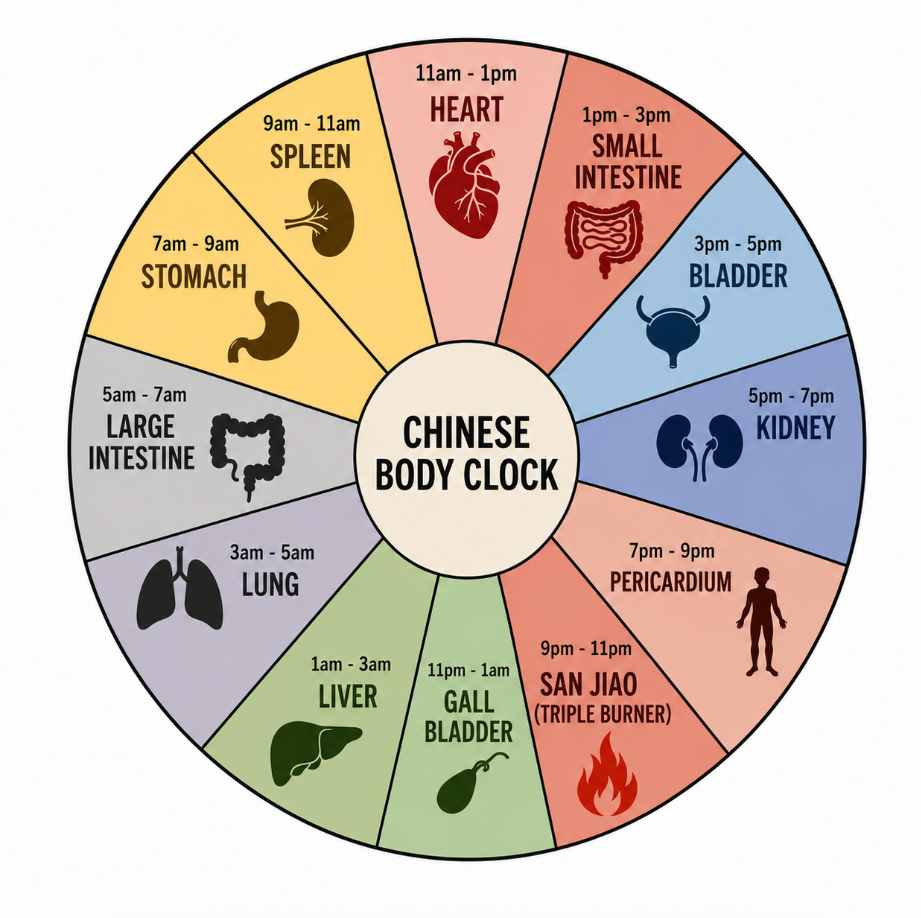
According to TCM theory, Qi (energy) is thought to circulate through different organ systems over a 24-hour cycle. Each organ system is traditionally associated with a two-hour period during which its functions are considered to be most active.
For example:
3 am – 5 am: Lung system
5 am – 7 am: Large Intestine system
7 am – 9 am: Stomach system
9 am – 11 am: Spleen system
11 am – 1 pm: Heart system
1 pm – 3 pm: Small Intestine system
3 pm – 5 pm: Bladder system
5 pm – 7 pm: Kidney system
7 pm – 9 pm: Pericardium system
9 pm – 11 pm: San Jiao (Triple Burner)
11 pm – 1 am: Gallbladder system
1 am – 3 am: Liver system
These organ systems represent functional relationships within traditional Chinese medicine and are not directly equivalent to the anatomical organs recognised in Western medicine.
Does waking at 3 am mean you have a Liver problem?
Not necessarily.
One of the biggest misconceptions is that waking at the same time every night automatically identifies the cause of a health concern.
Traditional Chinese Medicine doesn't work that way.
A registered Chinese medicine practitioner would never diagnose someone based solely on the time they wake during the night. Instead, sleep is considered alongside many other factors, including:
Your overall health history
Energy levels
Digestion
Stress
Temperature preferences
Tongue observation
Pulse assessment
Other symptoms you may be experiencing
The Chinese Body Clock is just one traditional framework that may contribute to a broader assessment—it is not a diagnostic tool on its own.
Why do people wake during the night?
There are many reasons why sleep may be interrupted.
These can include:
Stress or anxiety
Pain or discomfort
Hormonal changes
Sleep disorders
Environmental factors such as noise or temperature
Certain medications
Alcohol or caffeine
Medical conditions
If you're regularly waking during the night or your sleep is affecting your daily life, it's important to discuss this with your GP or another appropriate healthcare professional.
How does TCM view sleep?
In Traditional Chinese Medicine, sleep is considered an important time for restoration and maintaining balance.
Rather than focusing on a single symptom, practitioners look at the quality of sleep as part of a person's overall health.
Questions may include:
Do you have trouble falling asleep?
Do you wake frequently?
Do you wake feeling refreshed?
Are there vivid dreams?
Do you feel tired during the day?
These answers help build a picture of your overall pattern according to traditional Chinese medicine principles.
Where modern sleep science overlaps
Modern research shows that our bodies naturally follow circadian rhythms—24-hour cycles that influence sleep, hormone production, body temperature and many other biological functions.
Traditional Chinese Medicine developed its own understanding of daily rhythms centuries before modern sleep science emerged.
Although these two systems are based on different theories and should not be considered equivalent, both recognise that the body follows natural daily patterns and that good sleep is an important part of overall wellbeing.
Should you worry if you always wake at the same time?
Not necessarily.
Many people experience occasional waking during the night, and there are numerous possible explanations.
Rather than trying to diagnose yourself based on the clock, it's more helpful to look at the bigger picture. Consider your sleep habits, stress levels, overall health and any other symptoms you may be experiencing.
If sleep problems are persistent or worsening, a healthcare professional can help investigate possible underlying causes.
A balanced approach
The Chinese Body Clock remains a fascinating part of Traditional Chinese Medicine and provides insight into how health has been viewed within this system for centuries.
While it shouldn't be used to diagnose medical conditions, it can form part of the broader assessment undertaken by a registered Chinese medicine practitioner.
At Warrnambool Acupuncture & Chinese Medicine, we take an individualised approach to your health. Every consultation considers your symptoms, health history and overall wellbeing before discussing whether acupuncture or Chinese herbal medicine may be appropriate as part of your broader healthcare approach.
If you'd like to learn more about Traditional Chinese Medicine or discuss your sleep concerns, we'd be happy to help.